Learn to read music, one note at a time.

Reading sheet music isn't a gift: music theory is a skill, and it is built from short, repeated doses. Cléo cuts it into two-minute lessons you can do standing on a train, with no instrument and no gear. Start from zero, or from wherever you are.

Free on the App Store. iOS 18.0 or later.

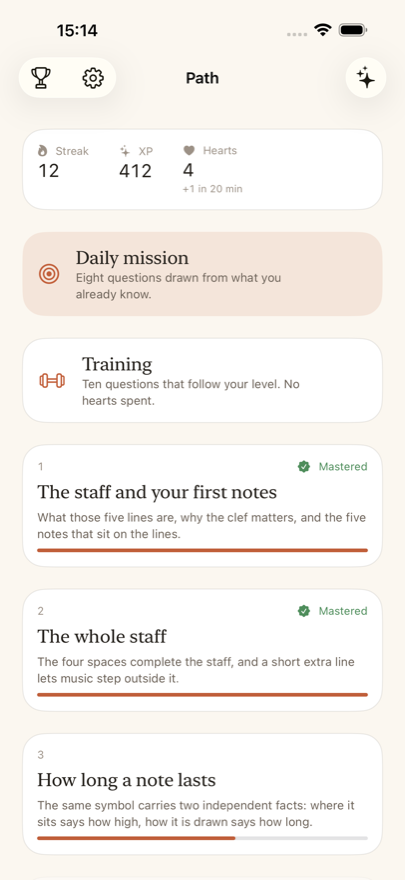
The path screen: streak, experience points and lives at the top, then the daily mission, training and the list of chapters.

What is Cléo?

Cléo is an iPhone app that teaches sheet music reading and music theory, in English and French. The course is entirely free: nine chapters, 41 two-minute lessons, 370+ exercises, from the staff to key signatures and ear training. Cléo requires no account, no microphone, and no instrument.

In action

The course, screen by screen

Not mockups: the app exactly as it runs on an iPhone.

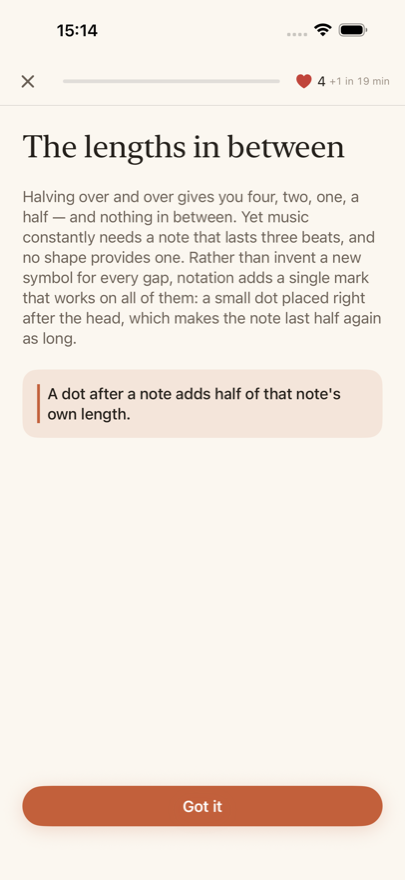
A theory card explaining the augmentation dot: a few sentences of text followed by the rule to remember.

It explains before it asks

  • Every idea opens with a theory card: where the rule comes from, what it's for, what to remember
  • Most apps drill rules; Cléo tells you where they come from, and a rule you understand doesn't need revising
  • Then the exercise arrives, on the sign just explained, one at a time
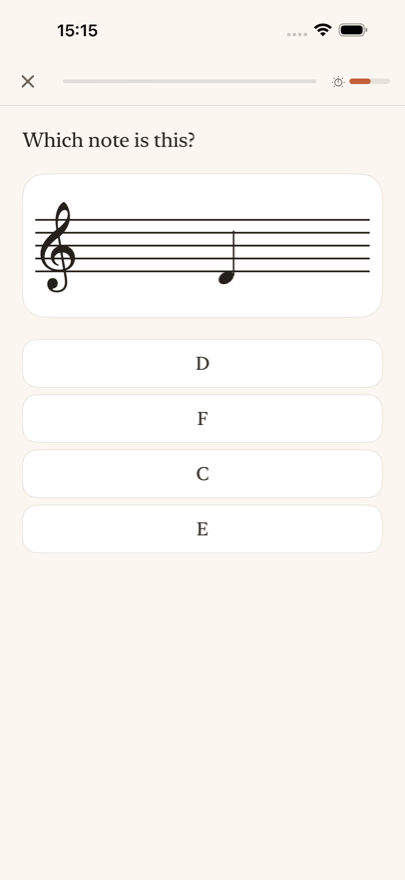
The training screen: a note on a treble staff, four names to choose from, and a difficulty gauge in the top right.

Training tunes itself to your level

  • One note, four answers: reading stays sharp through short repetition, not through practice sessions
  • Difficulty follows what you get right, without you having to pick it
  • Treble clef and bass clef, the daily mission, and the streak that carries from one day to the next
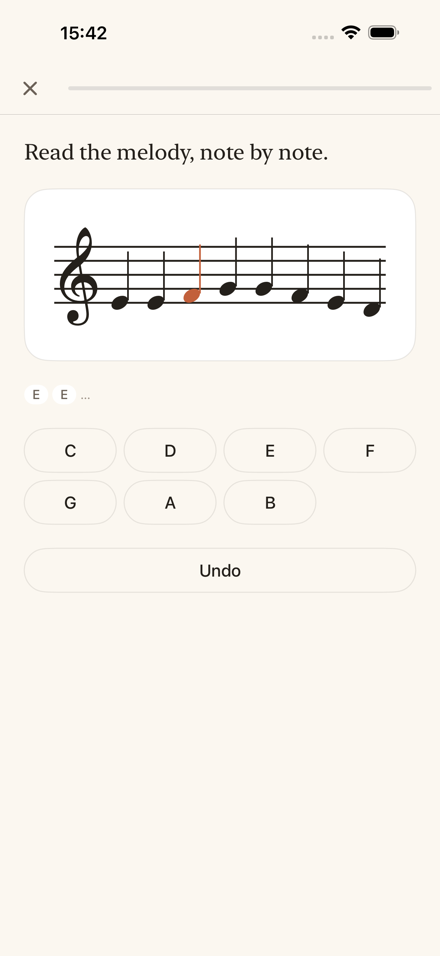
A sight-reading in progress: the melody of the Ode to Joy on a treble staff, the expected note highlighted, and the seven note names to choose from below.

Then real scores, to sight-read

  • From the second chapter, a catalogue of twenty-seven scores opens: the Ode to Joy, Pachelbel's Canon, Amazing Grace, Scarborough Fair, Sur le pont d'Avignon, public domain, written whole: thirty to seventy notes each, phrase by phrase, with their rhythm
  • The whole melody stays on screen and is read start to finish: the one gesture exercises never teach, since they always announce what they are asking for
  • Every note you name is played back: yours, never the one you were meant to find. At the end of a phrase, the melody you have just read sounds with its rhythm, and you recognise it
Why Cléo

We explain the why, not just the what

Why a notehead is hollow or filled, why a stem flips direction halfway up the staff, why a second clef exists at all. Here's what you'll be able to do by the end of the course.

Read any note

The five lines, the four spaces, and everything that spills past the staff, in treble clef and bass clef alike.

Read durations

Whole, half, quarter and eighth notes, dots and ties. Position tells you the pitch, shape tells you the time.

Understand rests

Whole, half, quarter and eighth rests, and why silence gets written down instead of left blank.

Decode a bar

Bar lines, time signatures and what those two numbers actually mean, on examples you can count through.

Accidentals and key signatures

Sharps, flats, naturals, and the key signature at the start of the staff that settles the whole piece at once.

The why behind each rule

Not just the rule: the reason for it. That's the difference between revising something and remembering it.

A full music theory course, from your first landmark to key signatures. From “these five lines mean nothing to me” to reading a score, chapter after chapter.
Preview

What it looks like

Three more screens, untouched.

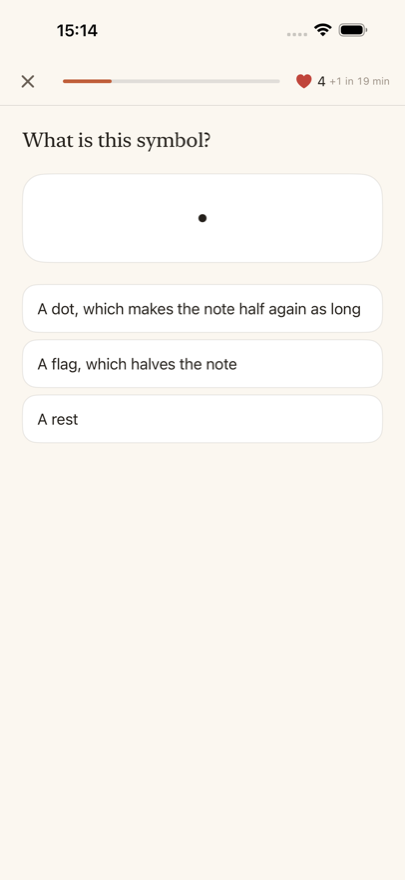
An exercise: the augmentation dot alone in a frame, with three definitions to choose from.
Know the signs, one at a time.
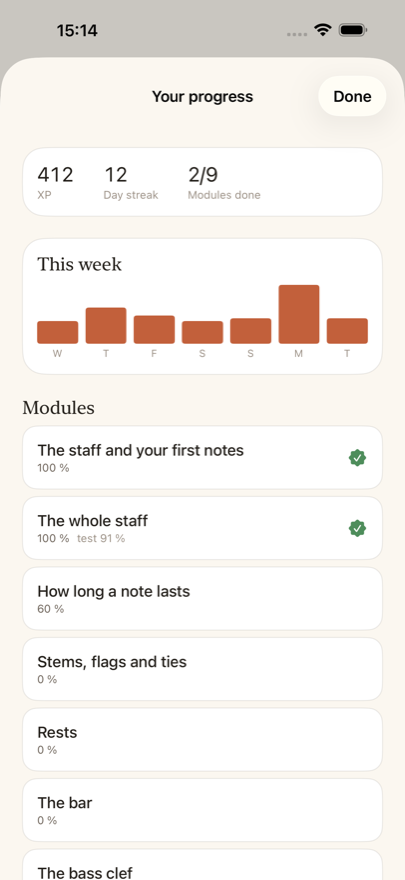
The progress screen: experience points, day streak and completed modules, a chart for the week, then the list of modules with their percentage.
Progress, module by module.
The path screen: streak, experience points and lives at the top, then the daily mission, training and the list of chapters.
The path, with the daily mission.
How it works

Open, learn, come back

No account, no server: everything happens on your iPhone.

1

Start from scratch, or don't

No prerequisites: for a complete beginner, the first chapter starts at the five lines of the staff and the names of the notes. If you already read music, a placement test opens the chapter where it stops being obvious.

2

Two minutes of lesson

The rule gets explained, then you get asked about it. Enough to fit the wait on a station platform rather than a practice session.

3

Keep what you know

The daily mission, the streak and adaptive-difficulty training keep your reading fresh between chapters.

Pricing

The whole course is free

Every chapter, all 41 lessons and every exercise, with no exceptions. The subscription unlocks no lesson: it removes the ads, gives unlimited lives and opens the score catalogue.

Free
$0

The complete course, no exceptions. Limited lives, an ad now and then, an optional video to earn a life back, and one score of your choice to sight-read.

Subscriptions are managed and cancelled from your Apple account settings. Nothing is sent to a server: your progress stays on your phone.

Download

The music reading app for iPhone

Cléo is distributed exclusively on the App Store: nothing to install by hand, no permission to grant in your settings.

Available on the App Store

Free download. The whole course opens with no payment and no account.

Download on the App Store
  • iPhone, iOS 18.0 or later
  • English and French, picked from your phone's language
  • No account, no sign-up, no connection needed to learn
  • No microphone access: everything is done by tapping, one-handed
Support

Frequently asked questions

Can you learn to read sheet music without an instrument?

Yes. Reading a score and playing an instrument are two separate skills. Cléo teaches reading only: recognising notes, durations, rests and bars. Everything is done by tapping the screen, with no instrument and no gear.

Does Cléo listen to me play?

No. The app never asks for microphone access and never listens, at any point. Exercises are answered by tapping the screen, one-handed.

Is Cléo free?

The course is entirely free: all nine chapters, all 41 lessons and all 370+ exercises, with no exceptions. The optional subscription ($4.99 per month or $39.99 per year in the United States, €4.99 and €34.99 in the eurozone) removes the ads, gives unlimited lives and opens the whole catalogue of scores to sight-read. It unlocks no lesson.

Do I need to know any music theory to start?

No. The first chapter starts from the five lines of the staff and assumes nothing. If you already read music, a placement test finds what you know and opens the chapter where it stops being obvious.

How long is a lesson?

About two minutes. The course has 41 lessons across nine chapters, built to fit the wait on a station platform rather than a practice session.

Can you sight-read real scores in Cléo?

Yes. A catalogue of twenty-seven public-domain scores opens once you can read the whole staff, at the second chapter: Beethoven's Ode to Joy, Pachelbel's Canon, Bach's Prelude in C major, Brahms's Lullaby, the Largo from the New World, Amazing Grace, Scarborough Fair, Molly Malone, Sur le pont d'Avignon, Alouette, Cadet Rousselle, and seasonal pieces in December. These are whole pieces, thirty to seventy notes, cut into phrases and written with their rhythm. Every note you name is played back, and the phrase replays in full once you have read it. One score of your choice is free; the subscription opens the whole catalogue.
Something wrong, or a question?

Write to contact@eyland.app, we answer directly.